
Reviewed · WALKING TOURS
Innercity Walking Tour
Johannesburg can feel big and hard to read from a car. This walking-focused tour makes it smaller fast, by putting you on the street with a guide and showing you places that most quick city stops skip. You get a clear sense of how the city has changed, from creative revival to major landmarks and names tied to South Africa’s story.
I especially like the way the tour blends on-foot street time with guided public-transport know-how, so you’re not just looking, you’re learning how people actually move around. Another big plus is the mix of stops, from Maboneng’s art-led energy to a tall stack of secondhand books at Collectors Treasury. The one drawback to consider: it’s a moderate walking experience (4 hours), so comfortable shoes matter.
If you’re hoping for mostly stand-and-stare sightseeing, this may feel a bit more like walking with a mission. You’ll cover several neighborhoods and spend real time inside markets and buildings, so plan to keep your pace steady.
Key highlights you should care about
- Maboneng Precinct, Place of Light energy you can see in the street art and storefronts
- Kwa Mai Mai Traditional Market with lots of stalls and traditional goods, all in an old stable setting
- Collectors Treasury, 8-storey secondhand bookstore plus LPs, maps, postcards, and more
- Carlton Centre skyline views and a narrated timeline of Johannesburg’s big eras
- Gandhi Square and Chancellor House with names and context tied to law, activism, and Mandela boxing history
- Small group size up to 20 plus an active pace, guided commentary, and tickets included
Entering Johannesburg on Foot, Not Through a Bus Window
What makes this tour feel worth your time is the approach. Instead of seeing Johannesburg mostly through glass, you walk through the city’s layers with a guide and get the kind of context that turns streets into a story. You’re also learning city rhythm, not just city facts.
For me, the best part is the combination of guided storytelling and practical city skills. The tour includes time to understand public transportation, which helps you later when you’re planning your own day. And because skip-the-line access and admissions are part of the experience, you spend more time where it counts.
One practical note: this is a 4-hour format with multiple stops and short transitions. That’s great for momentum, but you’ll want to show up ready to walk. Bring water, wear grippy shoes, and keep your bag organized so you’re not stopping every 10 minutes.
More Walking Tours in Johannesburg
- Soweto: Walking Tour with a Local Guide and Lunch
★ 4.9 · 648 reviews - Soweto Walking Tour with Lunch
★ 5.0 · 288 reviews - Johannesburg: Local Food Tasting Guided Walking Tour
★ 4.7 · 192 reviews
Jeppestown meeting point and how the tour actually moves
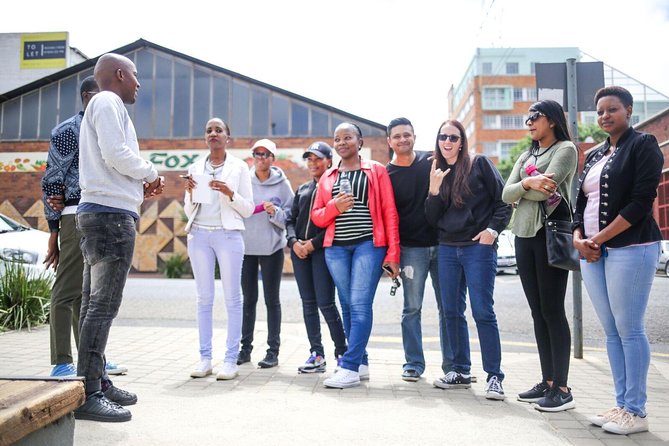
You meet at 302 Fox St, Jeppestown, and the tour ends back at the same meeting point. It starts at 10:00 am, and you’ll have a mobile ticket for the experience. The operator includes an air-conditioned vehicle, so expect at least some transfers or comfort breaks, even though the main focus is on foot.
Because there’s a maximum of 20 travelers, the group stays manageable. That matters in neighborhoods where you want space to hear your guide and not feel packed in. It also tends to make questions easier, especially when the guide is explaining how routes, timing, and local habits work.
Moderate fitness is the line they state for a reason. This tour is not for people who want to sit the whole time. You’ll be on sidewalks and moving between destinations, plus spending real time inside markets and buildings. If you pace yourself and take your time at each stop, it feels doable.
Maboneng Precinct, Place of Light and the art-driven revival
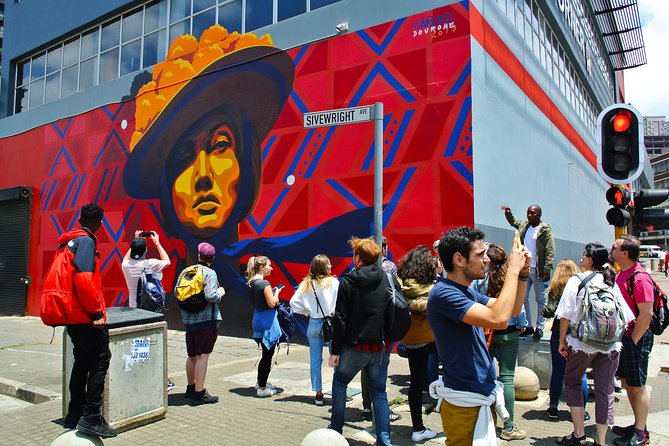
Your first stop is Maboneng Precinct, a district named for its meaning, Place of Light. This is Johannesburg’s inner-city transformation story in street form. Not long ago, the area was widely seen as unsafe due to urban decay, but creative work in design, art, and entrepreneurship helped change that perception.
What you’ll actually notice is the physical change: more activity around creative storefronts, more visible street art, and a neighborhood vibe that feels like it’s being made in real time. This isn’t just about photos, either. Your guide’s commentary helps you connect what you see to why it matters, so the colorful walls and packed pedestrian corners become part of a bigger picture.
You’ll spend about 45 minutes here. That’s enough time to get your bearings, notice the art, and understand what “revitalization” means on the ground. It’s also a good moment to pick up souvenir ideas that fit local style, especially if you like handmade or design-forward items.
Kwa Mai Mai Traditional Market, where the old stable still shapes the feel
Next comes Kwa Mai Mai Traditional Market, one of the oldest markets in Johannesburg. The setting is part of the charm: it used to be an old horse stable, and that history shows in the layout and character of the place. Now it’s filled with over 176 stalls, so you can browse without feeling like you’re stuck in a tiny shop.
This stop is designed for authentic shopping, not just looking. You’ll find traditional medicines, African attire, beaded items, artefacts, walking sticks, and craft works. If you want souvenirs that feel connected to everyday culture, this is where you’ll spend your time.
You’ll get about 30 minutes at the market. That’s enough time to compare items, ask questions, and decide what you actually want to carry home. Tip from a practical traveler standpoint: go in with a mental list, like one small wearable item and one craft-based souvenir, so your budget doesn’t get steamrolled by cool things at every turn.
Also remember that markets are busy. Keep your phone secured, move slowly, and let your guide lead so you’re not unsure about where to turn next.
Something different for the Johannesburg list:
- From Johannesburg: Pilanesberg Nature Reserve Game Safari
★ 4.8 · 1,327 reviews - Johannesburg: Hop-On Hop-Off Bus with Optional Soweto Tour
★ 4.6 · 985 reviews - Soweto /Johannesburg and Apartheid Museum Guided Full Day Tour
★ 5.0 · 932 reviews - Johannesburg Hop-On Hop-Off City Tour with Soweto Option
★ 4.5 · 768 reviews
Collectors Treasury, the 8-storey secondhand book stack
Then you’ll head to Collectors Treasury, described as the largest secondhand bookstore in the Southern Hemisphere. This isn’t a quick browse-and-leave stop. It’s an 8-storey building where books are stacked all over, plus LPs, maps, porcelain, and postcards.
What I love about this kind of stop is that it connects you to people through objects. Even if you don’t buy anything, you can feel the collecting culture, the nostalgia, and the way everyday life turns into a library of memories. Your guide’s talk helps you make sense of the place beyond the wow factor.
You’ll only have about 15 minutes here, so be strategic. If you’re book-minded, pick a section you want first, scan the covers quickly, and look for something that feels like Johannesburg or South Africa rather than a generic travel read. If you’re more record or postcard-focused, head straight to those sections and don’t get distracted by every stairwell.
Even with limited time, this stop is memorable because it’s physical. You’re surrounded by stacks, not just passing a bookshelf.
Carlton Centre skyline views and the city timeline you can hear
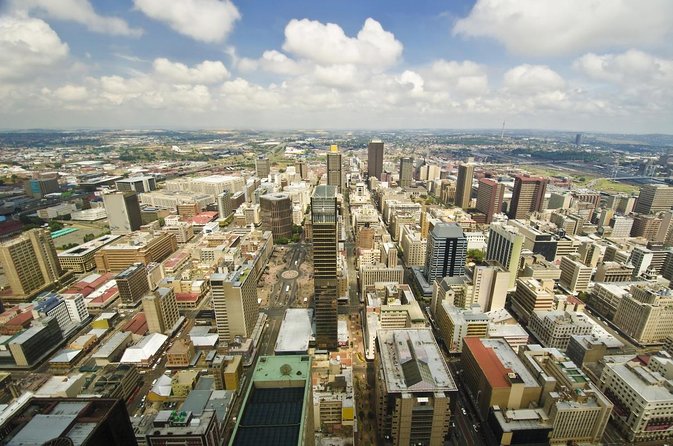
After that, you’ll reach the Carlton Centre, a major Johannesburg landmark. It was built between 1969 and 1976 by the American architectural firm Skidmore, Owings and Merrill. The building reaches 223 meters above the city, and you’ll get panoramic views from up there.
But the view is only half the point. This stop includes narration that ties the skyline to history, starting with the gold rush in 1886, then moving through the urban decline in the late 1980s and 1990s, and finally the re-birth of the city centre. That pacing matters because it gives your eye a timeline. Instead of just seeing tall buildings, you understand what those eras did to Johannesburg.
You’ll spend about 1 hour here, including the viewpoint time and the storytelling. It’s a solid chunk in a 4-hour schedule, meaning it anchors the tour. If you want one stop to summarize the city’s contradictions, this is it.
Practical advice: viewpoints can be bright, so protect your eyes and bring a cloth or lens wipe if you’re sensitive to glare. Also, plan to take your photos, then listen. The narration is the real value-added part.
Gandhi Square and Chancellor House, names tied to law and Mandela
The tour continues into areas connected to major figures and legal history.
First is Gandhi Square Precinct, named after Mahatma Gandhi. Your guide will connect the name to his South African years, including that he spent 21 years in South Africa and had a law firm in downtown Johannesburg. This stop is short, about 20 minutes, but it’s effective because it ties street-level naming to real time lived in the country.
Then comes Chancellor House, reached by a walk through the main street mining district. In the 1950s, the building housed Mandela and Tambo Attorneys, South Africa’s first black-owned law firm. Across from the old law firm stands The Shadow Boxing Sculpture, created by artist Marcos Cianfanelli based on a famous image by Bob Gosani of young Mandela boxing.
This part of the tour is about context, not just architecture. The walk helps you link the setting to the people. And the sculpture gives a visual metaphor you can remember long after the tour ends.
You’ll spend about 30 minutes here, which is enough time to slow down, notice details, and let the guide connect the dots.
Skip-the-line access and ticketed stops, how that affects your day
The tour includes admission tickets for the stops and also includes skip-the-line access to landmarks. That sounds like a small perk until you’ve been stuck waiting in a queue while the day slips away. Here, it protects your time, especially since the schedule is tight and the day is only about 4 hours total.
It also helps that the key stops are spread across different “types” of places. You’re not just moving between museums. You’re mixing neighborhoods, a market, a book store, a skyscraper viewpoint, and historical sites. The included tickets keep the focus on the walking and learning instead of admin tasks.
You’ll also get guided commentary as you walk, which is where these places stop feeling like random stops and start feeling like a connected story.
Public transportation know-how you can use later
One of the tour highlights is learning how to navigate Johannesburg’s public transportation. The city can be intimidating if you only rely on apps and car rides. This kind of practical guidance is valuable because it makes you a more confident independent traveler.
You might not leave with a perfect map of every route, but you will likely learn how to think about getting from one area to another, what to pay attention to, and how to approach travel with less guesswork. And since the tour uses a mix of walking and an included vehicle, it’s a helpful preview of how time and distance feel in real conditions.
This is also why I like the small group size. With fewer people, your guide can better adjust to the pace and questions that come up.
What to pack for 4 hours of walking and stop time
Because you’re on foot for most of the experience, your comfort drives your enjoyment. Here’s what I’d bring based on how the tour is structured: comfortable walking shoes, sunscreen or a hat if the sun is out, a light layer if it feels cool in the shade, and a small refillable water bottle.
Also, plan for purchases. There’s an actual shopping market, plus the book store has lots of items beyond books. If you buy something fragile like porcelain, you’ll want a secure bag and gentle handling.
If you hate carrying extra weight, keep your shopping intentions small and prioritize items you can fit easily. If you like shopping, bring a little extra space in your day bag so you’re not cramming on the walk back.
Price and value: is $50.04 a good deal?
The price is $50.04 per person, for a roughly 4-hour experience. The included basics are important: air-conditioned vehicle and all fees and taxes. On top of that, admission tickets are included at multiple stops, and you get guided commentary plus the skip-the-line benefit.
So the real question is whether you’re paying for transport and entry fees you would otherwise figure out yourself, or paying for an actual guided plan that saves you time and adds context. This tour does more of the second.
If you love walking, history with street context, and photo moments that have meaning, this price feels like a fair trade. If you only want a quick highlight reel and don’t care about markets or viewpoints, you might find the walking-heavy format not worth it.
A good compromise: if you’re staying near Jeppestown or you’re comfortable heading into the inner-city on foot with a guide, this feels like one of those “get the context fast” experiences.
Who this Johannesburg tour fits best
This is a strong fit if you:
- want to see Johannesburg through neighborhood stops, not just major sights
- like shopping with context, especially at markets
- enjoy skyline viewpoints that come with a timeline
- care about legal and activist history connected to real buildings and art
It’s also a good match if you like guides who are friendly and responsive. One comment I kept thinking about was the warmth of a guide named Brite, described as super friendly and upbeat, and that kind of energy matters during a walking tour because it keeps you curious instead of rushing.
If you’re someone who hates walking between stops or you’re not steady on your feet, consider shorter, more seated options.
Should you book this Innercity Walking Tour?
I’d book it if you want Johannesburg to feel personal and readable. The mix of Maboneng, the traditional market, the book stacks, and the landmark viewpoints gives you both culture and city-scale perspective in one morning block. The guide-driven commentary and the included tickets are the difference between a scattered walk and a guided day that actually teaches you something.
I would skip it if you prefer minimal walking, you’re not interested in markets or history context, or you want a pure sightseeing route with no stop-inside time.
If you do go, commit to comfortable shoes, a calm pace, and a willingness to look at street life closely. This tour rewards that mindset.
FAQ
What is the price of the Johannesburg Innercity Walking Tour?
The price is $50.04 per person.
How long is the tour?
The tour lasts about 4 hours.
Where is the meeting point, and where does the tour end?
You meet at 302 Fox St, Jeppestown, Johannesburg, 2043, South Africa, and the activity ends back at the meeting point.
What time does the tour start?
The start time is 10:00 am.
Do I get a mobile ticket?
Yes, the tour uses a mobile ticket.
What’s included in the price?
The price includes an air-conditioned vehicle and all fees and taxes, and admission tickets are included for the stops.
Is lunch included?
No, lunch and refreshments are not included.
What fitness level do I need?
You should have a moderate physical fitness level.
How large is the group?
The maximum group size is 20 travelers.
What is the cancellation policy?
You can cancel for a full refund up to 24 hours in advance of the experience start time. If you cancel less than 24 hours before, the amount you paid is not refunded.
Newest reviews around Johannesburg
- Johannesburg: 3-Day Panorama Tour with Kruger Park Safari★ 5.0 · 7 reviews
- Drakensberg Mountains. Tugela Gorge and Amphitheater Hike★ 5.0 · 7 reviews
- 5-Day Kruger National Park Safari including Breakfast and Dinner★ 4.5 · 7 reviews
- Aerial cableway Hartebeespoort Halfday tour★ 4.5 · 7 reviews
- Soweto Township Tour★ 5.0 · 7 reviews
- Private Safari Tour: Pilansberg National Park Big 5★ 5.0 · 7 reviews
- Historical and Cultural Interactive Experience of Soweto★ 5.0 · 7 reviews
- Soweto Tour★ 5.0 · 7 reviews
Walking Tours, compared.



Browse the lists this tour appears in