
Reviewed · JOHANNESBURG TOURS
Johannesburg: The Evolution of Maboneng (Place of Light)
Maboneng, a Motho word for a place of light, is interesting because the neighborhood tells its story with your feet. In two hours, you connect arts, architecture, and everyday Johannesburg life in a part of town that has been changing fast for years.
I especially like the focus on street art murals made by local and international artists. I also like the mix of stops that go beyond photos, including the Kwa Mai-Mai Traditional Healers Market and the big second-hand bookshop.
One drawback to consider is that this is a walking tour. It is not recommended for people with limited mobility, and it is best when you can stay on your feet for the full route.
Key highlights you should know
- Maboneng as Place of Light, with neighborhood history tied to what you see on the street
- Cosmopolitan building stops, including a heritage landmark built in 1899 and opened as a hotel and bar in 1902
- Public art that turns barriers into conversations, including the Mandela mural area
- Upcycled housing at Drive-lines, using shipping containers for affordable homes
- Arts On Main and William Kentridge’s scene, connected to his foundation work
- Shopping stops with real local flavor, from Kwa Mai-Mai healers to The Collectors Treasure bookshop
Place of Light: What Makes Maboneng a Smart 2-Hour Choice
Maboneng works well as a short tour because it is built for walking. You are not trying to fit in a museum marathon. You are moving through streets where art, old buildings, and new development sit close enough to compare in real time.
The name alone gives you a hint about the attitude here. Maboneng means a place of light, and the neighborhood has a habit of using visible creativity to change perceptions. Murals brighten dull walls, new buildings make the area feel less temporary, and public art shows up where you would normally expect just blank concrete.
This tour is also a good “starter taste” of Johannesburg’s city-energy. Instead of focusing only on one headline attraction, it threads through a chain of places that each explain a different piece of the urban story.
Put these Johannesburg options head to head
- From Johannesburg: Pilanesberg Nature Reserve Game Safari
★ 4.8 · 1,327 reviews - Johannesburg: Hop-On Hop-Off Bus with Optional Soweto Tour
★ 4.6 · 985 reviews - Soweto /Johannesburg and Apartheid Museum Guided Full Day Tour
★ 5.0 · 932 reviews
Starting at Curiocity Backpackers, Then Walking East Into Downtown
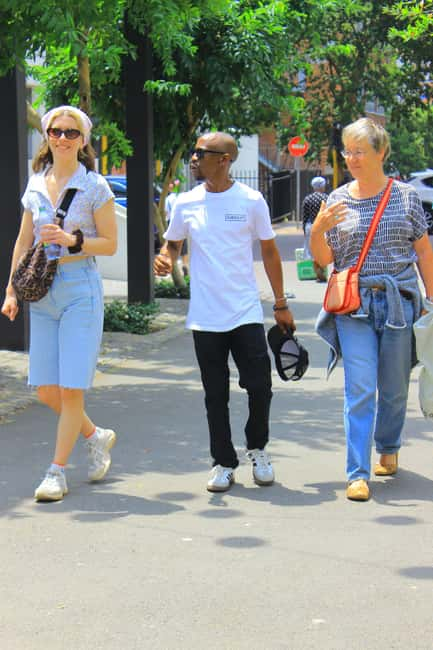
Your route starts at Curiocity Backpackers, 302 Fox St, Jeppestown. You meet your guide there, then head into the creative eastern side of downtown Johannesburg. The group is on foot from the first minute, so comfortable shoes matter more than you might think.
The tour format is simple and practical. You keep moving, you stop often enough to absorb details, and you get context as you go. Expect the day to be about seeing how the neighborhood changed over roughly the last couple of decades, not about long lectures.
One small tip: you will cover enough streets that you should dress for the weather and keep your hands free. If you bring a bag, make sure it is easy to manage while you’re looking up at murals and down at uneven sidewalks.
First Suburbs and Street-Art Clues: How the Story Gets Told on the Sidewalk
A big part of the value here is how the guide connects Johannesburg history to what you see today. You learn about the heritage of the city’s early suburbs, then your walk becomes a set of visual clues. You start noticing how old and new elements share the same blocks.
Then comes the main event for many people: murals painted by both local and international artists. These murals are not random decoration. They mark territory, honor people, and often turn blank walls into public storytelling.
As you wander, look for the contrast. Some walls feel like an open-air timeline, showing shifts in style and subject. Other walls feel like a message board. Either way, you’ll get better photos if you slow down and let your eyes travel across the wall in layers.
Also, keep your expectations grounded. A walking tour can’t freeze time. You will see a lot, but you will not linger for hours at every corner. If you want to read every detail in a mural, plan to spend a minute or two more at the stops that grab you most.
The Cosmopolitan Heritage Stop: Built in 1899, Remembered in 1902
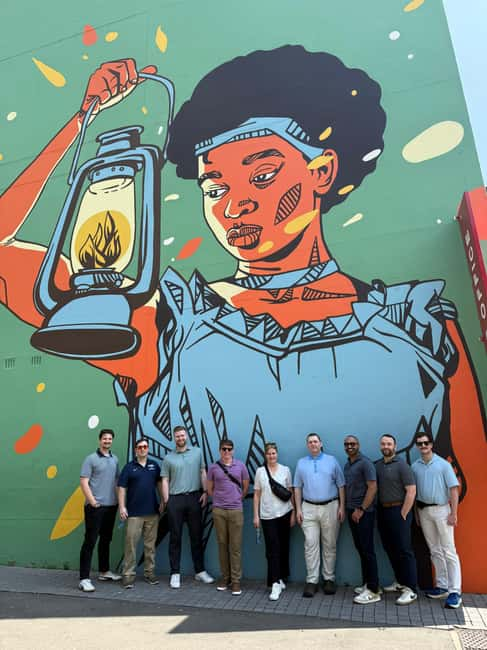
One of the clearest heritage moments is a stop at The Cosmopolitan, one of the elegant heritage buildings in downtown Johannesburg. It was built in 1899, then opened as a hotel and bar in 1902.
This kind of stop matters because it gives you a baseline. Without a place like this, Maboneng’s new energy can feel like it appeared out of nowhere. With it, you can sense how the city reused its bones while new ideas moved in.
If you like architecture, this is where you should pay extra attention. Notice how heritage buildings still shape the streetscape, even when the neighborhood around them has changed. And if you’re more of a people-watching type, remember that buildings like this have a history of social life, so the vibe around them tends to feel more layered than a modern block.
Something different for the Johannesburg list:
- Johannesburg Hop-On Hop-Off City Tour with Soweto Option
★ 4.5 · 768 reviews - Full Day Ultimate Pilanesberg National Park Safari from Johannesburg or Pretoria
★ 4.5 · 718 reviews - Half-Day Tour of Soweto Tour
★ 4.5 · 712 reviews - Soweto: Walking Tour with a Local Guide and Lunch
★ 4.9 · 648 reviews
Drive-lines and Upcycled Containers: Affordable Housing With a Visible Design Plan
Next you head to Drive-lines Development, a newer urban project that uses upcycled shipping containers as affordable housing. This is the kind of stop that turns theory into something you can point at.
You are not just being shown a concept. You’re shown a physical system: containers repurposed, arranged, and made into homes. Even if you don’t fully understand the planning details, you can still read the intention in the design.
It also changes how you think about regeneration. Urban renewal is often described as construction and cleanup. Here, it is tied to a more specific idea, making housing options more attainable while keeping a design language that stands out.
For you, that means this part of the tour is not only visual. It pushes you to connect the murals with the reality of who gets to live in a changing city.
Mandela Mural Walls and Nelson Makamo’s Open-Air Museum
After Drive-lines, you walk toward the area marked by the Mandela mural. It connects to Nelson Mandela’s legacy, and it’s especially easy to recognize if you remember the leader-boxer reference that’s associated with the mural.
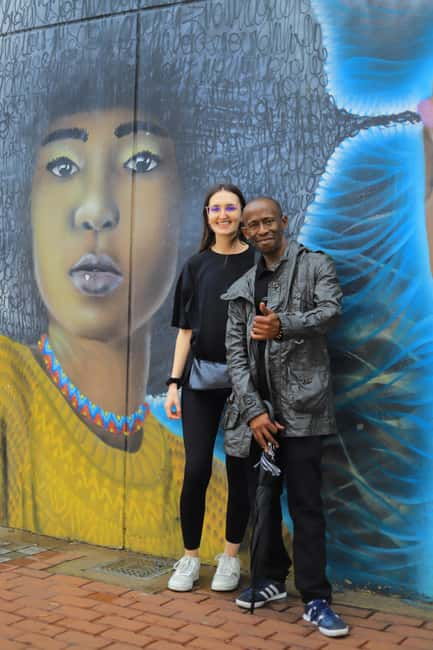
Then you move into an area where public art shows how it can break barriers. Walls can create barriers in a city. Here, the art is the counter-move, turning separation into something more interpretive and public.
You also get to see murals by Nelson Makamo, described as an open-air museum. Even if you’re not an art expert, this is the kind of stop where your eyes start doing the work. Step back, then step closer. Try to catch how different pieces work together across space.
This portion is one of the most praised parts of the experience because it makes the neighborhood feel intentional. You’re not just seeing art. You are seeing art used as urban communication.
Arts On Main and William Kentridge: When Art Moves Beyond the Walls
One of the key cultural stops is Arts On Main, which is home to William Kentridge. The area also connects to his foundation, the Center For The Les Good Idea.
This isn’t just a gallery stop with a quick look. It is tied to a recognized creative figure and the institutional side of creative work, where art is supported and extended beyond one-off exhibitions.
For you, this adds depth. Murals on the street show how art can live at eye level. Arts On Main shows a different path, where the same creative energy has organizational support.
Even if you are not familiar with Kentridge already, you will still understand the logic of the place once you connect it to the rest of your walk. It’s the difference between a single message and a whole system of making.
Kwa Mai-Mai Traditional Healers Market: Real Trade, Real Culture
Then you shift into something more grounded: the Kwa Mai-Mai Traditional Healers Market. It is said to be one of the oldest markets in the city, and this stop is where Maboneng feels most distinctly like Johannesburg, not just a curated street-art zone.
Here you will encounter Sangomas, traditional healers, along with traditional medicines and clothing. Even if you do not plan to buy anything, this is a chance to observe how traditional practice is part of everyday commerce and identity.
A smart approach: take your time, but stay respectful. This is not a souvenir shop designed for a quick photo. It is a working market, so ask questions only when you feel invited to.
If you came for the murals and architecture, this market stop might be the surprise you remember most. It adds a human layer that keeps the story balanced.
The Collectors Treasure: South Africa’s Largest Second-Hand Bookshop Stop
For many people, the tour ends with a shopping moment that feels surprisingly therapeutic. You stop at The Collectors Treasure, described as the largest second-hand bookstore in the southern hemisphere.
This is a great final stop because it gives you a reset. You’ve been walking through walls, buildings, and market stalls. Now you can slow down, browse, and bring something back that is personal rather than purely visual.
If you like books, this is the easiest way to turn travel into something you can hold after you go home. If you do not, still try to spend a few minutes here, because second-hand bookstores often capture local reading tastes and the kinds of topics people come back to.
And yes, buying a book mid-tour is also a practical move. It is lighter than souvenirs that you might regret packing.
Sun-downer Over Johannesburg Skyline: The Optional Finish
If time allows, your tour may end with a sun-downer overlooking the Joburg skyline. This is a nice way to land the experience. You spend two hours moving through the neighborhood, then you get a wider view to close the loop.
Even if you don’t stay for the full sunset moment, it helps to step away from the street-level details. From up above, Maboneng’s story reads differently, and you can see how it fits into the bigger urban picture.
Because this depends on time, treat it as a bonus, not a guarantee.
Price, Pace, and Who This Tour Fits Best
The price is $42 per person for a 2-hour guided walking tour. For a downtown neighborhood route with multiple stops, including heritage, public art, and two distinct shopping or cultural locations, that can be fair value. You are paying for guidance, timing, and the ability to connect the dots between art and place.
That said, walking tours have a reality check. This is more about movement than about sitting down with big attractions. If you want a tour that feels like a series of indoor experiences, this is probably not the best match.
It is also not suitable for everyone. It is not recommended for people with limited mobility, and it is not suitable for pregnant women. If you fall into either category, you should look for a different format that offers more flexibility and less walking.
Who should go? If you like street art, urban change, and short cultural routes with practical stops, you will likely enjoy this. If you prefer slow travel with long stops, you might find the pace a bit tight, but you can still get a lot by focusing on the mural stops and the two market-style visits.
Should You Book the Johannesburg: The Evolution of Maboneng Tour?
Book it if you want a compact, walking-friendly way to understand how Maboneng uses public art, heritage, and development to tell a city story. You get an art-forward route that also includes real-world cultural and shopping stops, including the healers market and a major second-hand bookstore.
Skip it if you need low walking volume or you have mobility constraints, because this tour is designed around walking. Also skip it if you only want a traditional sightseeing pattern with ticketed attractions, because this is street-level and guide-led.
If your goal is to get your bearings fast and see what makes this part of Johannesburg feel different, this tour is a strong pick. It is the kind of experience that leaves you looking at walls, buildings, and people with more attention than you had when you arrived.
FAQ
How long is the Maboneng walking tour?
The tour lasts 2 hours.
Where does the tour start and end?
It starts at Curiocity Backpackers, 302 Fox St, Jeppestown, Johannesburg, and ends back at the meeting point.
What is the price per person?
The price is $42 per person.
What language is the tour in?
The tour is in English.
What is included in the tour price?
The included activity is a 2-hour guided walking tour.
What should I bring for the walk?
Bring comfortable shoes and weather-appropriate clothing.
Is the tour suitable for people with limited mobility or pregnant women?
It is not recommended for people with limited mobility, and it is not suitable for pregnant women.
Is there anything I should not do during the tour?
Littering is not allowed.
Is there time for a sunset view?
Time willing, the tour may finish with a sun-downer overlooking the Joburg skyline.
Newest reviews around Johannesburg
- Johannesburg: 3-Day Panorama Tour with Kruger Park Safari★ 5.0 · 7 reviews
- Drakensberg Mountains. Tugela Gorge and Amphitheater Hike★ 5.0 · 7 reviews
- 5-Day Kruger National Park Safari including Breakfast and Dinner★ 4.5 · 7 reviews
- Aerial cableway Hartebeespoort Halfday tour★ 4.5 · 7 reviews
- Soweto Township Tour★ 5.0 · 7 reviews
- Private Safari Tour: Pilansberg National Park Big 5★ 5.0 · 7 reviews
- Historical and Cultural Interactive Experience of Soweto★ 5.0 · 7 reviews
- Soweto Tour★ 5.0 · 7 reviews
Johannesburg Tours, compared.


Soweto /Johannesburg and Apartheid Museum Guided Full Day Tour
Read our review →Johannesburg Hop-On Hop-Off City Tour with Soweto Option
Read our review →
Full Day Ultimate Pilanesberg National Park Safari from Johannesburg or Pretoria
Read our review →

Jo’berg in 1 Day: Soweto, Apartheid Museum & City Tour
Read our review →Browse the lists this tour appears in